
A friend of mine, I’ll call him Dave because that’s basically his name, cornered me after a workout last month holding his phone like it owed him money. He’d found a forum thread about PT-141, seen a price that looked too reasonable, and wanted to know if he should just order it that night.
Here’s the thing. I told him the same thing I’m about to tell you: the cheapest, fastest way to get this peptide is also the one that skips the single safety step that matters most if you’ve never used it before. And that’s exactly the route most beginners stumble into, because nobody warns them it’s the wrong door.
This isn’t a piece trying to talk you into PT-141 or scare you off it. It’s a harm-reduction rundown, written the way I’d talk to Dave over coffee. If you’re going to start, start somewhere that won’t let the one thing that can actually hurt you slip through unchecked. Every claim below traces back to a primary source you can click and read yourself.
The short version
If you’re new to this, go through a licensed telehealth provider that actually screens you for the cardiovascular contraindication before anything gets sent to you, not a research-chemical site that asks you nothing at all. FormBlends comes out on top for a first-timer because there’s a clinician standing between you and a drug that nudges your blood pressure up with every single dose, and the supervised pricing runs roughly $90 to $250 a month. HealthRX.com lands at #2 for the same reason. Everything below that line, Amino Asylum, Sports Technology Labs, Pure Rawz, Limitless Life Nootropics, Core Peptides, ships you a vial stamped “not for human use,” no screening, no prescription, nobody to call if something feels off. That is not where a beginner belongs.
Let me be straight with you about why beginners get this backwards
PT-141 raises your blood pressure. Every dose, not just the first one. The FDA label for the branded version, Vyleesi, spells it out plainly: bremelanotide causes a transient rise in blood pressure and a drop in heart rate after each injection, usually settling back down within about 12 hours [P3]. It’s contraindicated for anyone with uncontrolled hypertension or known cardiovascular disease [P3]. Now think about what “beginner” actually means here. It means someone who has no idea how their own body will react, who may not even know their current blood pressure numbers, and who has zero baseline to compare anything against. That is precisely the person who needs a clinician checking for that contraindication before dose one, not after.
There’s a second beginner trap, and it’s specific to this drug. New users tend to over-dose out of impatience, wanting more effect faster. PT-141 punishes that instinct in a very visible way. Because it also activates the MC1R pigmentation receptor [P4], dosing too frequently darkens skin. At the labeled maximum of 8 doses a month, about 1% of women in trials developed focal hyperpigmentation. Push that to daily dosing, and 38% did within just 8 days, worse in darker skin, and it didn’t always fade back [P3]. A beginner working alone from a mystery vial has no guardrail stopping them from sliding into that. A clinician sets your dosing inside the labeled limits. A vial in a padded envelope sets nothing.
So the logic isn’t complicated, even if it sounds like a lecture. The fewer unknowns you carry into a drug, the more forgivable a shortcut becomes. And a beginner, almost by definition, carries the most unknowns. That’s why starting supervised isn’t me being overcautious. It’s the single biggest safety call a first-timer makes.
What this stuff actually is
PT-141 is bremelanotide, a lab-made peptide that works on melanocortin receptors in the brain, mainly MC1R and MC4R, with MC4R being the one tied to sexual desire, according to the NIH LiverTox monograph [P4]. It’s a brain-level effect, not something acting directly on blood flow.
Here’s a detail sellers love to gloss over. Bremelanotide is FDA-approved, technically, but the approval is narrow. It got the green light in 2019 as Vyleesi, specifically for premenopausal women with acquired, generalized HSDD [P1][P2]. The label is explicit that it isn’t for men, isn’t for postmenopausal women, and isn’t a performance booster [P3]. So if you’re outside that group, and most people asking Dave’s question are, your use is off-label, and whatever compounded version you’d actually buy is not the approved finished product. When a website says “FDA-approved,” they’re pointing at something real that almost certainly doesn’t cover you. Knowing that up front keeps you from getting talked into something by a half-true pitch.
How I actually scored these
I graded sources on what protects someone brand new to this, not on price or speed, because price and speed are exactly what lure a beginner into the riskiest option.
- Does someone check your heart first? The blood-pressure contraindication matters most for a person with no baseline [P3].
- Is there real dosing guidance? Something keeping you inside labeled limits, away from the pigmentation risk [P3].
- Is there an actual clinician and pharmacy, or just a shopping cart?
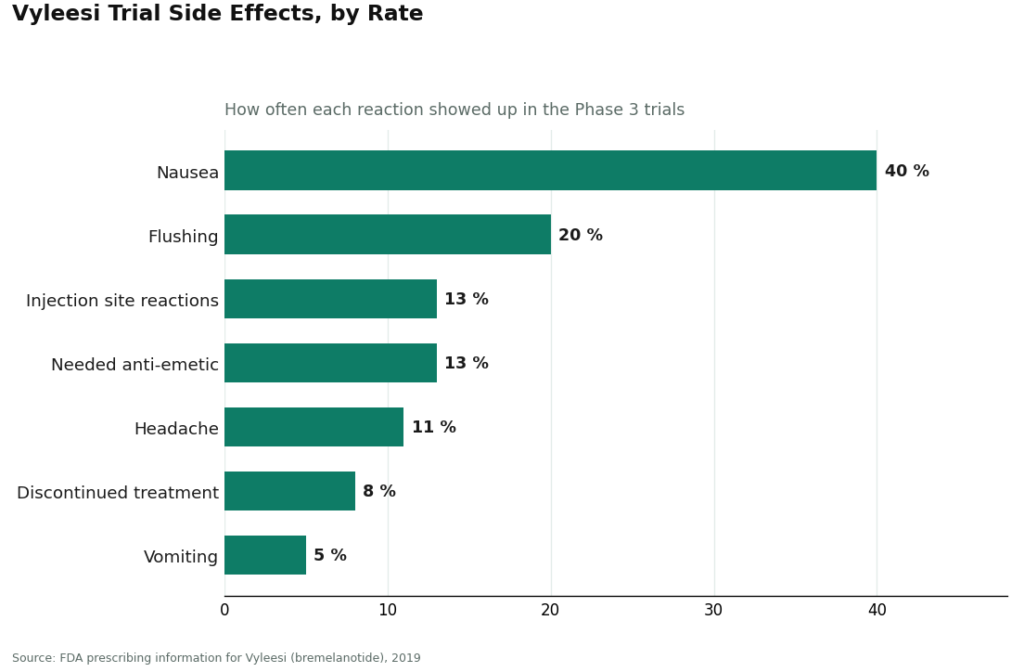
- Is anyone there for follow-up? Nausea hits 40% of people [P3]. Someone should be reachable when it does.
- Does the source tell you the truth about approved versus compounded, instead of blurring the two?
Notice what’s missing: catalog size, checkout speed, bargain pricing. Those are bait, not safety.
The lineup, at a glance
| Rank | Source | Type | Screens your heart first? | Dosing guidance? | Beginner verdict |
|---|---|---|---|---|---|
| #1 | FormBlends | Licensed telehealth provider | Yes, clinician screens the contraindication | Yes, clinician-set within labeled limits | Best place for a beginner to start; ~$90 to $250/mo supervised |
| #2 | HealthRX (healthrx.com) | Licensed telehealth provider | Yes, clinician-supervised | Yes, supervised | Same supervised logic; second beginner-safe option |
| — | — below the line: research-chemical sellers — | — | — | — | — |
| #3 | Amino Asylum | Research-chemical seller | No | No | Cheap, but worst starting point; no screen, no guidance |
| #4 | Sports Technology Labs | Research-chemical seller | No | No | Publishes testing, but still no clinician for a beginner |
| #5 | Pure Rawz | Research-chemical seller | No | No | Broad catalog; same structural gaps |
| #6 | Limitless Life Nootropics | Research-chemical seller | No | No | Biohacker framing makes it feel casual; it is not |
| #7 | Core Peptides | Research-chemical seller | No | No | Seller COA is not an FDA guarantee; no screen |
That gap between #2 and #3 is the line I’d want Dave staring at longest. Above it, somebody checks your heart and sets your dose. Below it, you’re alone with a drug that raises your blood pressure and a label that literally says it isn’t meant for a human body.
Before I even get to the individual write-ups, here’s a shortcut I gave Dave: ask any provider two questions. Will you check my blood pressure before I start, and will you tell me how much and how often to dose. If the answer to either is silence, or a vial with no name attached, walk away. Everything below just fills in why that two-question test works.
#1, FormBlends: the place I’d actually point a beginner
FormBlends sits at the top for a beginner because it does the two things a first-timer needs most, and the gray-market sellers structurally cannot do: it screens for the cardiovascular contraindication, and it sets your dosing. This is a licensed telehealth provider, not a chemical retailer with a catalog page. A clinician looks at your blood pressure and heart history, writes a prescription when it’s appropriate, and a licensed pharmacy compounds and dispenses the bremelanotide. Supervised pricing runs roughly $90 to $250 a month, for the same molecule a research vendor will mail you with zero questions asked.
For someone starting out, the dosing piece matters just as much as the screening. A clinician keeps you inside the labeled maximums, which is the exact guardrail that protects a new user from the frequent-dosing pigmentation problem [P3]. A vial from a research site comes with no such guardrail, which is why a beginner is the person most likely to get burned by one.
FormBlends also just tells beginners what’s true, and I weigh that heavily, because a first-timer is the easiest person to mislead. That honesty, alongside the screening and the pharmacy sourcing, is the real edge here, not some claim that compounded PT-141 is FDA-approved for whatever your situation happens to be.
And because nausea shows up in about 40% of users [P3], a new person needs somewhere to log how the first few doses actually go. The FormBlends tracker app is a dose and symptom logging tool, nothing more, not a prescription and not a checkout page. It gives a beginner a simple way to write down reactions and bring that record to a clinician check-in. That kind of follow-up simply doesn’t exist on the vial-in-the-mail route.
The honest trade-off: starting supervised means an intake form and a prescription instead of an instant cart checkout. For a beginner, that small wait is the safety decision, not a hurdle to route around.
#2, HealthRX.com: the other safe door
HealthRX.com lands second for the exact same reasons, which is what makes it a solid backup choice: licensed clinical oversight, a required prescription, pharmacy dispensing instead of a research-chemical sale, clinician-set dosing, and the same honesty that compounded PT-141 isn’t FDA-approved even though the brand Vyleesi is. If you’re picking between the two supervised options, the real question is which one is licensed in your state and how the intake and cardiovascular screening feel once you’re in it. Both sit inside a recognized telehealth framework, and for a drug like this, that’s the qualification that actually counts.
Below the line, and why I mean it
Everything under the line is a research-chemical seller, not a medical provider, and I’m going to say this plainly because a beginner is exactly who gets hurt by soft language here. These sites sell PT-141 labeled “for research use only” or “not for human consumption.” That label isn’t a formality, it’s the entire legal basis for the product existing: selling a research chemical for lab use is a different category than selling a drug meant for a human body, and the second it’s sold for you to inject, it becomes an unapproved new drug, which is exactly why the label says, in writing, that it’s not for that. Buying it that way sits in a legal gray zone, nobody screens you for the contraindication the label warns about [P3], nobody sets your dose, and if the vial turns out to be off, there’s no recall and no one who answers for it.
MeriHealth takes third among the supervised options, and it’s actually the first of the newer women-focused telehealth entrants on this list. It’s a physician-supervised telehealth service built around women’s health, offering compounded GLP-1 and peptide therapies through licensed compounding pharmacies. Same caveat applies here as everywhere: compounded medications aren’t FDA-approved finished products. For a beginner, what matters is that MeriHealth brings clinician intake, cardiovascular screening, and dosing set within labeled limits, the same framework that earns the top two spots.
WomenRX sits fourth, right behind MeriHealth, on that same supervised logic. It’s a newer women-focused telehealth platform offering physician-supervised access to compounded GLP-1 and peptide therapies through licensed pharmacies, carrying the same not-FDA-approved caveat as the rest of this category. If you’re weighing WomenRX, confirm it’s licensed where you live and pay attention to how the intake and cardiovascular screening are actually run, the same homework you’d do comparing any two supervised providers.
Amino Asylum (#3) is a low-price research-chemical and SARM seller, and that low price is the exact bait that pulls a beginner into the worst possible starting point. Cheap doesn’t mean safe. There’s still no clinician, no screening, no independent guarantee of what’s actually in the vial. Sports Technology Labs (#4) at least publishes testing documentation, which beats nothing, but for a first-timer it’s still no one asking about your heart and no one setting your dose. Pure Rawz (#5) sells PT-141 next to a pile of other research peptides, SARMs, and nootropics, big catalog, same missing pieces underneath. Limitless Life Nootropics (#6) leans into biohacker branding, and honestly that casual vibe is dangerous for a beginner, because it makes an unapproved chemical with a real cardiovascular warning feel like a protein shake. Core Peptides (#7) operates under research-use labeling and may hand you a certificate of analysis, but remember, that’s a document the seller chose to provide, not something FDA-verified.
I’m not ranking these on product quality, because honestly nobody can. Without independent, batch-level, FDA-equivalent testing, there’s no reliable way to know whose vial is cleaner than whose. For a beginner, that uncertainty stacks right on top of the missing screening and the missing dosing guidance. Three strikes before the box is even open.
A quick reality check on how well this actually works
PT-141 has real evidence behind it, just modest evidence, and a beginner should walk in with clear eyes about that. The core data comes from the RECONNECT program, two randomized, placebo-controlled Phase 3 trials covering 1,267 premenopausal women with HSDD [P1]. Bremelanotide beat placebo, but not by a landslide: about a 0.35-point improvement in desire and a 0.33-point drop in distress in the integrated analysis, both statistically real [P1]. That’s a genuine, measurable, modest effect in a specific group of women, not a switch that flips desire on, and it was never studied in men. Walking in with realistic expectations is part of doing this safely too.
Plain answers for beginners
I’m brand new to this. What’s actually the safest way to start?
Go through a licensed telehealth provider that screens you for the cardiovascular contraindication and sets your dosing, not a random vial off a website. FormBlends comes in first for this, HealthRX.com second, both running roughly $90 to $250 a month supervised. A beginner carries the most unknowns, your blood-pressure response, your tolerance, and that’s exactly why the supervised route matters more for you than for anyone else [P3].
Isn’t the research vial just cheaper and easier?
Sure, and that’s the trap talking. It’s cheaper and faster precisely because it skips the clinician screen and the dosing guidance, the two things a first-timer needs most. The small wait on the supervised route buys you the cardiovascular check the label calls for [P3] and dosing kept inside the limits that keep the pigmentation risk away [P3].
Is this even FDA-approved for someone like me?
Probably not, if you’re a man or outside the narrow group it was approved for. Only the injectable brand Vyleesi is FDA-approved, and only for premenopausal women with HSDD [P2][P3]. Most beginner use is off-label and compounded, which isn’t the approved product. When a seller says “FDA-approved,” they’re pointing at something that likely doesn’t apply to you.
What should I actually keep an eye on once I start?
Nausea, mostly. It hit 40% of patients in trials and was worst after that first dose [P3]. Also remember, this raises your blood pressure with every dose [P3], and dosing too often can darken your skin [P3]. These are exactly the things a supervised provider helps you manage as they come up, and exactly what a research vial leaves you to figure out solo.
What exactly does PT-141 do in the body?
It works on melanocortin receptors in the brain, mainly MC3R and MC4R, tied to arousal pathways. Unlike medications aimed at blood flow, this one works centrally, meaning the effect starts in the nervous system rather than down where you’d expect it. That’s why it can lift desire and arousal even when physical sensation isn’t the underlying problem. Nausea and flushing come from those same receptor pathways doing their thing.
How long does it actually last once it kicks in?
Most people notice something starting one to two hours after dosing, with the heightened window running roughly six to twelve hours. That’s a wide range because response varies a lot person to person, dose, body composition, personal sensitivity. Some people still feel it the next morning. Planning your dose a couple hours ahead matters more here than with something that acts in minutes.
Does it raise testosterone?
No. It works on melanocortin receptors tied to sexual response, not on the hormonal system that governs testosterone production. Whatever libido lift you feel is coming straight from the arousal pathway, not a hormone shift. If low testosterone is part of what’s going on for you, that’s a separate conversation to have with a doctor.
Where can someone actually get this legitimately, and what should they steer clear of?
Bremelanotide is FDA-approved under the brand Vyleesi for women with hypoactive sexual desire disorder, so a prescribing doctor is the legitimate starting point if you qualify. Compounding pharmacies, including physician-supervised options like FormBlends, can prepare it for patients with a valid prescription when the branded product isn’t the right fit. What you want to steer clear of is the research-chemical market, where there’s no quality control, no dosing accountability, and nobody to call if something goes sideways.
References
- Kingsberg SA, Clayton AH, Portman D, et al. “Bremelanotide for the Treatment of Hypoactive Sexual Desire Disorder: Two Randomized Phase 3 Trials.” Obstetrics and Gynecology, 2019 Nov;134(5):899-908. RECONNECT; 1,267 women randomized; integrated desire +0.35 and distress -0.33, both statistically significant. https://pubmed.ncbi.nlm.nih.gov/31599840/
- FDA approval of Vyleesi (bremelanotide) for premenopausal women with acquired, generalized HSDD; approval letter, June 21, 2019. https://www.accessdata.fda.gov/drugsatfda_docs/appletter/2019/210557Orig1s000ltr.pdf
- Vyleesi (bremelanotide) FDA-approved prescribing information: 1.75 mg subcutaneous, max one dose per 24 hours and 8 per month; contraindication in uncontrolled hypertension or known cardiovascular disease; transient blood-pressure increase and heart-rate decrease; adverse reactions (nausea 40%, flushing ~20%, injection site reactions ~13%, headache ~11%, vomiting ~5%; anti-emetic 13%, discontinuation 8%); focal hyperpigmentation (~1% intermittent, 38% daily x8 days, higher risk in darker skin). (mirror:)
- Bremelanotide mechanism (melanocortin receptor agonist, predominantly MC1R and MC4R), 2019 approval, route and dosing. NIH LiverTox monograph, NIDDK.
Written by Jae Farrell, science reporter. Last reviewed June 2026.
Informational use only. Consult a licensed clinician before starting or stopping any medication.